
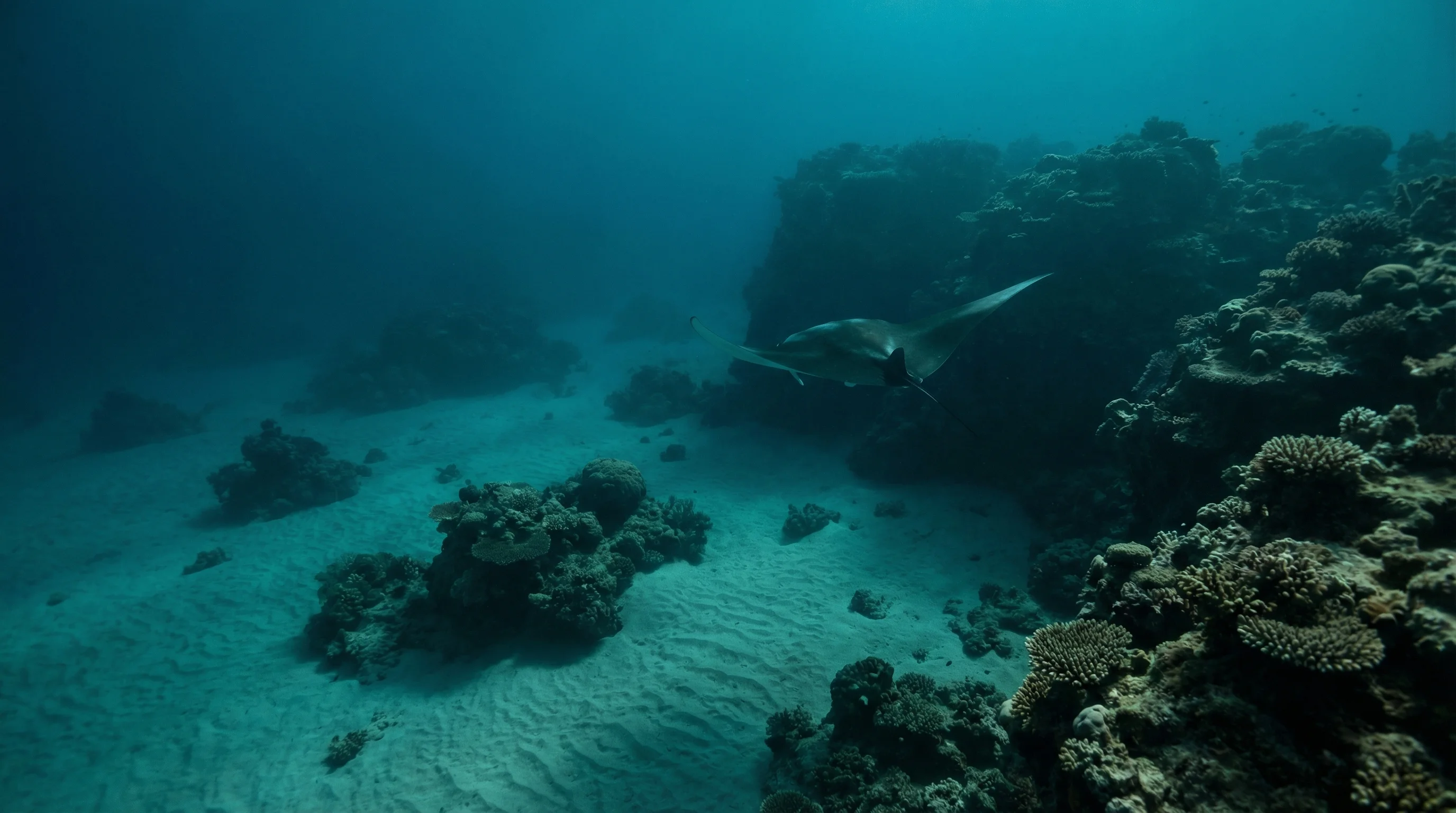
Frederick Reefs sits far offshore in Queensland's Coral Sea, an isolated reef system that rewards serious divers with visibility stretching to 90 metres and walls that plunge to 40 metres. The topography covers everything from shallow reef crests at 1 metre down through vertical drop-offs, swim-throughs, and caves. Moderate currents funnel pelagic life past the walls consistently, bringing grey reef sharks, white tip reef sharks, hammerhead sharks, manta rays, and large schools of big eye trevally and barracuda into view. Gorgonian fans line the deeper sections, while potato cod and humphead parrotfish work the shallower reef. Decompression diving is a realistic prospect here, and strong current surges, jellyfish, and sharp coral demand full attention on every dive.
-20.96670, 154.38300
Plan your bottom time carefully before you enter, as the depth and current at Frederick Reefs make decompression obligations a genuine risk rather than an edge case. May through November offers the most stable conditions for this remote boat-access site.
Access is only possible via multi-day liveaboard charters, which typically depart from mainland Queensland ports like Gladstone or Cairns.
The site is extremely remote, making emergency assistance distant. Divers must be self-sufficient and experienced. Currents can be unpredictable.
Depth
1-40m
Visibility
30-90m
Skill Level
Advanced
Entry
Boat
Boat required
Current
Moderate
Best Time
May, Jun, Jul, Aug, Sep, Oct, Nov
No nearby dive sites found within 50km.
Frederick Reefs in the Coral Sea, Queensland, is renowned for pelagic encounters including grey reef sharks, white tip reef sharks, and hammerhead sharks. Divers regularly observe manta rays, schools of tuna and barracuda, big eye trevally, and potato cod on the reef structures.
Frederick Reefs requires an advanced diving certification due to depths reaching 40 metres and moderate to strong currents. The remote Coral Sea location and decompression diving conditions demand experienced divers with proper training in deep diving and current management.
Frederick Reefs is accessible only by liveaboard boat from the Queensland coast, with no shore access available. The remote Coral Sea location requires multi-day dive expeditions, and there are no facilities at the site itself.
Frederick Reefs offers exceptional underwater visibility ranging from 30 to 90 metres throughout the year. The pristine Coral Sea waters and distance from the mainland ensure crystal-clear conditions ideal for spotting large pelagic species and observing the reef structures.
The optimal months for diving Frederick Reefs are May through November, covering the Australian winter and spring seasons. These months typically offer the most stable weather conditions for liveaboard operations and the best opportunities for hammerhead shark encounters.
Frederick Reefs presents several serious hazards including strong currents, depths requiring decompression stops, and sharp coral formations. Jellyfish can be present in the area, and the remote Coral Sea location means emergency services are several hours away by boat.
Frederick Reefs is not recommended for snorkelling despite shallow areas starting at 1 metre depth. The site is rated 1 out of 5 for snorkelling due to strong currents, remote location, and the fact that the best marine life encounters occur at depth with advanced diving experience required.
Frederick Reefs in Coral Sea requires advanced diving skills. Expect deeper depths, currents, or challenging conditions that are not suitable for newly certified divers.