
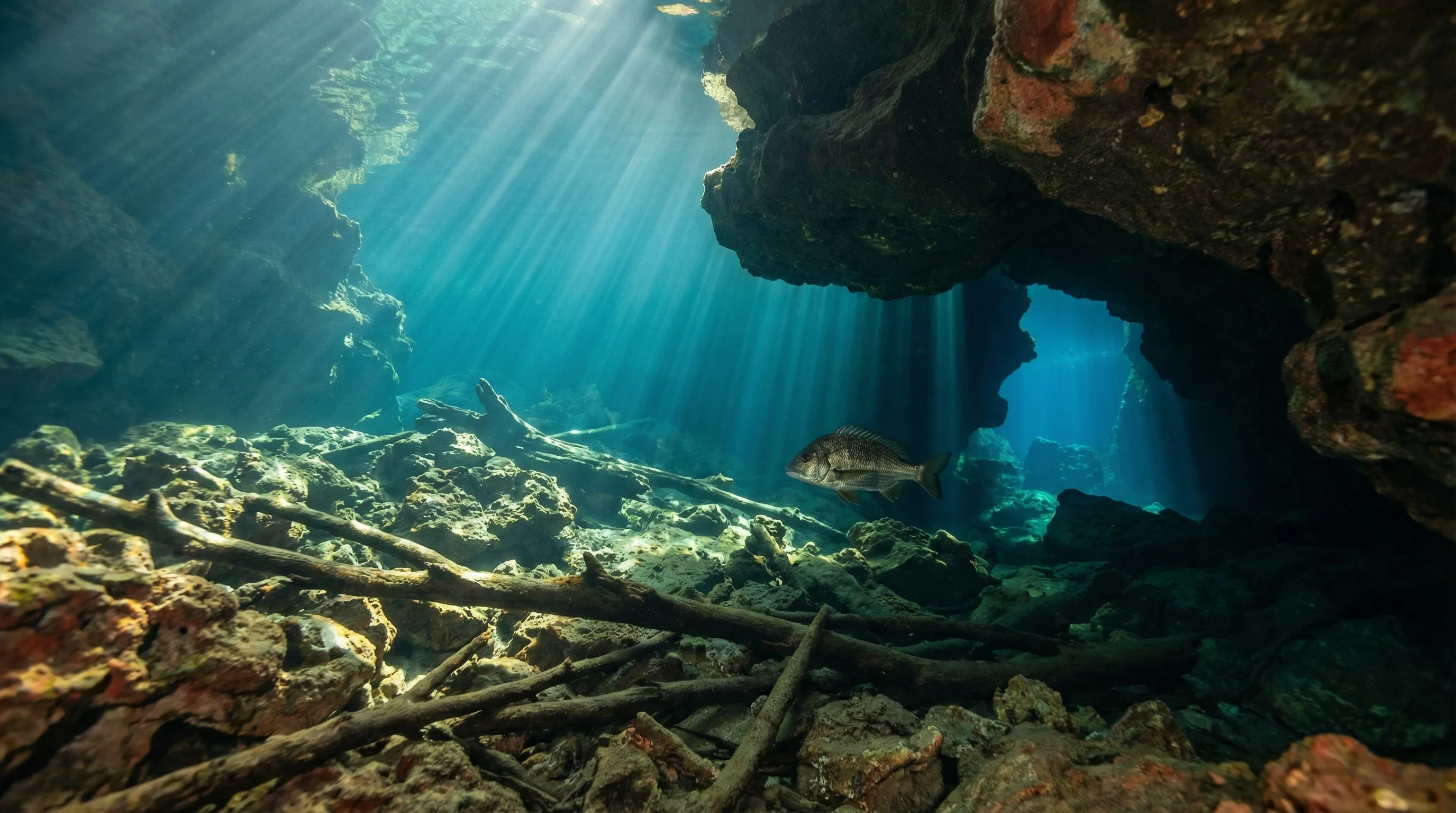
Hells Hole is a cave dive demanding full overhead environment training and solid buoyancy control before you even consider entering. Accessed from shore in South Australia, the site drops to 26 metres with variable visibility that can shift dramatically, making navigation and task-loading genuinely challenging. Currents are unpredictable, so arriving with redundant lighting and a solid dive plan is non-negotiable. Inside, freshwater eels inhabit the darker recesses and bream move through the water column. Entanglement risk is real, and cold water is a constant factor year-round. This is a site that rewards methodical, experienced cave divers who respect its conditions.
-37.00000, 140.00000
Carry at least two independent light sources and run a guideline on every penetration, regardless of how familiar you think you are with the cave. Visibility can deteriorate fast if silt gets disturbed, so disciplined finning technique is essential.
Access requires a permit from ForestrySA and membership with the Cave Diving Association of Australia (CDAA) or Australian Cave Explorers (ACE). The site is reached via a walking track from a small car park. Entry into the water is highly technical, requiring gear to be lowered by rope, followed by abseiling approximately 30 metres down to the water's surface. Exit is via a 30m+ wire ladder.
The primary hazard is the extremely difficult and technical entry and exit, which involves abseiling and a long ladder climb. This requires specialized training and equipment beyond standard scuba gear. Divers must wear their climbing harness during the dive. The site is an overhead environment requiring cave diving procedures.
Depth
0-26m
Visibility
10m
Skill Level
Expert
Entry
Shore
Water Temp
21-26°C
Typical Dive
30 min
Best Time
Year-round
No nearby dive sites found within 50km.
Hells Hole in Limestone Coast is a shore dive. Access requires a permit from ForestrySA and membership with the Cave Diving Association of Australia (CDAA) or Australian Cave Explorers (ACE). The site is reached via a walking track from a small car park. Entry into the water is highly technical, requiring gear to be lowered by rope, followed by abseiling approximately 30 metres down to the water's surface. Exit is via a 30m+ wire ladder.
Yes, parking is available near Hells Hole. Arrive early during peak seasons as spaces can fill up quickly.
Hells Hole in Limestone Coast is an expert-level site with demanding conditions. Only experienced divers with appropriate training and equipment should attempt this dive.
Diving at Hells Hole in Limestone Coast requires the following certifications: Cave, Deep, Open Water. Always dive within your training limits.
A 5mm wetsuit is recommended for diving at Hells Hole in Limestone Coast. Water temperatures range from 21°C to 26°C.
Hells Hole in Limestone Coast is home to freshwater eels and bream. Marine life sightings vary by season and conditions.
The best months to visit Hells Hole in Limestone Coast are January, February, March, April, May, June, July, August, September, October, November, and December. Conditions outside these months can still be good but are less predictable.
Hells Hole in Limestone Coast has a maximum depth of 26 metres.
A typical dive at Hells Hole in Limestone Coast lasts approximately 30 minutes. Actual dive time depends on depth, air consumption, and conditions.
Visibility at Hells Hole in Limestone Coast typically ranges from 10 metres to 10 metres. Conditions vary with weather, tides, and seasons.